
If your facility performs chrome plating, hard chrome finishing, or chromic acid anodizing you are legally required to treat hexavalent chromium before your wastewater leaves the building. Compliance is not optional. Under the Clean Water Act, civil penalties for non-compliance can reach $37,500 per day per violation. This guide explains exactly what hexavalent chromium is, why it is dangerous, what the law requires, and the precise three-step treatment process your facility needs to achieve compliance.
What Is Hexavalent Chromium and Why Is It So Dangerous?
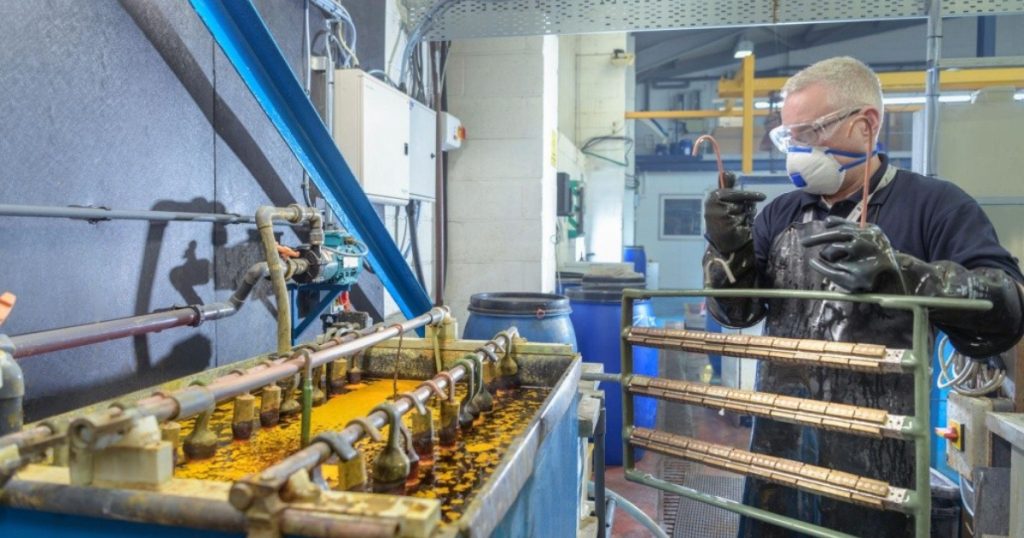
Chromium exists in two primary oxidation states in industrial settings: trivalent chromium Cr(III): which is relatively stable and far less hazardous, and hexavalent chromium
Cr(VI): which is acutely toxic and a known human carcinogen.
The International Agency for Research on Cancer (IARC) classifies Cr(VI) as a Group 1 human carcinogen the highest hazard classification possible. Exposure causes lung cancer, nasal septum ulceration, skin sensitization, and kidney damage. There is no safe threshold for occupational or environmental exposure.
Where Cr(VI) enters your wastewater:
- Hard chrome plating baths (chromic acid, CrO₃)
- Decorative chrome finishing operations
- Chromic acid anodizing processes
- Chromate conversion coating rinse waters
- Chrome passivation of stainless steel
Typical chrome plating baths operate at 250–400 g/L chromic acid concentration. Drag-out from the plating bath carried into rinse tanks typically introduces 50–200 mg/L Cr(VI) into your wastewater stream far above the legal discharge limit of 2.77 mg/L total chromium under 40 CFR Part 433.
The Legal Framework What the EPA Requires
Hexavalent chromium wastewater treatment is regulated under 40 CFR Part 433, Metal Finishing Point Source Category, established by the U.S. Environmental Protection Agency (EPA) and codified within the Electronic Code of Federal Regulations. These standards apply to facilities that generate and discharge wastewater from metal finishing operations, whether the discharge is directed to a publicly owned treatment works (POTW) or released directly to surface waters under a permitted discharge program. Compliance with these regulations is essential to ensure the proper management of chromium-bearing wastewater and to protect both environmental and public health.
Confirmed discharge limits under 40 CFR Part 433 (Subpart A):
| Standard | Daily Maximum | Monthly Average |
| Total Chromium (PSES) | 2.77 mg/L | 1.71 mg/L |
| Total Chromium (PSNS) | 2.77 mg/L | 1.71 mg/L |
Important: State and local discharge permits are frequently stricter than federal limits. California, for example, enforces a Cr(VI)-specific limit of 0.05 mg/L in many jurisdictions. Always verify your local POTW permit in addition to federal standards.
Facilities discharging regulated wastewater must also submit a Baseline Monitoring Report (BMR) to their local POTW authority and conduct regular self-monitoring. Non-compliance with 40 CFR Part 433 constitutes a violation of the Clean Water Act Section 309, with civil penalties of up to $37,500 per day per violation.
Note for chromium electroplating facilities: The EPA has proposed revisions to 40 CFR Part 433 to address PFAS discharges from chromium electroplating wastewater, with a Notice of Proposed Rulemaking planned for July 2026. Facilities should monitor EPA rulemaking updates at epa.gov/eg/electroplating-effluent-guidelines.
The 3-Step Treatment Process for Hexavalent Chromium Removal
Cr(VI) cannot be removed from wastewater by direct precipitation. It must first be chemically reduced to Cr(III) before it can be precipitated and filtered. The three-step process below is the established, EPA-recognized treatment method for hexavalent chromium removal from metal finishing wastewater.
Step 1: Chemical Reduction: Converting Cr(VI) to Cr(III)
The first step is chemical reduction converting the soluble, toxic Cr(VI) ion into Cr(III), which can then be precipitated and removed.
Reducing agents used in industrial practice:
| Reducing Agent | Notes |
| Sodium metabisulfite (Na₂S₂O₅) | Most common industrial method — effective, cost-efficient |
| Sodium bisulfite (NaHSO₃) | Similar to metabisulfite, slightly lower sulfur dioxide yield |
| Ferrous sulfate (FeSO₄) | Used where iron co-precipitation is acceptable |
Critical technical requirement: Reduction with sodium metabisulfite must occur at acidic pH 2.0–3.0. Outside this range, the reaction slows dramatically. Sulfuric acid is dosed to lower the pH before reducing agent addition.
Process verification: Use an ORP (Oxidation Reduction Potential) controller the ORP reading should reach +200 mV or lower to confirm complete Cr(VI) reduction to Cr(III). Do not rely on visual color change alone a yellow-to-green color shift indicates reduction is occurring, but ORP measurement is the only reliable confirmation.
Equipment required for Step 1:
- Reduction reaction tank with mechanical agitation
- pH dosing pump with sulfuric acid (H₂SO₄) feed
- ORP controller with probe
- Sodium metabisulfite chemical feed system
Step 2: Precipitation: Converting Cr(III) to Cr(OH)₃
After reduction, the pH of the wastewater is raised to precipitate the Cr(III) ions as insoluble chromium hydroxide Cr(OH)₃.
pH target for precipitation: Raise pH to 8.5–9.5 using caustic soda (NaOH) or hydrated lime Ca(OH)₂. Optimal precipitation occurs at pH 9.0.
Critical technical caution: If pH rises above pH 11, chromium hydroxide begins to re-dissolve as chromate ions reversing the treatment. pH control must be precise and continuously monitored by an automated pH controller. Manual addition of caustic is not acceptable for compliance-critical systems.
Lime vs. caustic soda:
- Hydrated lime Ca(OH)₂ is lower cost but generates approximately 2–3× more sludge volume
- Caustic soda (NaOH) is more expensive per unit but produces less sludge and is easier to handle in automated systems
Equipment required for Step 2:
- Precipitation tank with agitation
- pH controller
- Caustic soda or lime feed pump and dosing system
Step 3: Coagulation, Flocculation, and Filtration
After precipitation, the wastewater contains suspended colloidal Cr(OH)₃ particles that are too finely dispersed for effective gravity settling. Coagulation and flocculation are therefore essential treatment steps, promoting particle agglomeration into larger, settleable flocs that can be efficiently separated through clarification and filtration.
Coagulation: Add a coagulant chemical typically ferric chloride (FeCl₃), aluminum sulfate (alum), or polyaluminum chloride (PAC) to destabilize the electrical charge on the Cr(OH)₃ colloid particles. Rapid mixing for 1–2 minutes ensures uniform distribution. Determine the optimal coagulant dose for your specific wastewater through jar testing before full-scale implementation EPA guidance requires jar testing for system design.
Flocculation: Following coagulation, slow gentle stirring at 10–30 RPM encourages destabilized particles to collide and aggregate into larger, heavier floc. Flocculation residence time is typically 20–30 minutes. Add an anionic polymer flocculant aid to strengthen and weight the floc. Agitation must remain gentle aggressive mixing at this stage breaks up the fragile floc structure.
Clarification and filtration: The floc settles in a clarifier tank. The clarified effluent is then filtered through a sand filter or cartridge filter to polish remaining fine particles. Final pH adjustment to 6.0–9.0 ensures the effluent meets the pH range required for POTW discharge.
Target final effluent: < 1.0 mg/L total chromium provides a compliance margin against the 2.77 mg/L daily maximum limit.
Learn more about HPI Processes’ coagulation/flocculation/filtration systems →
Complete Equipment List for a Cr(VI) Treatment Train
A complete automated hexavalent chromium treatment system for a small-to-medium plating shop includes the following components:
- Equalization tank: buffers flow rate and concentration variations from batch plating operations
- Reduction reactor tank: pH/ORP-controlled reduction with acid and sodium metabisulfite feed
- Precipitation tank: pH-controlled caustic or lime feed for Cr(OH)₃ formation
- Coagulation/flocculation tank: coagulant and polymer feed with controlled mixing
- Clarifier or lamella settler: gravity separation of floc from clarified water
- Filter press: dewatering of Cr(OH)₃ sludge into dry cake for RCRA disposal
- Final pH adjustment tank: final effluent trim to pH 6.0–9.0 before discharge
The entire treatment train can be engineered as a compact skid-mounted automated unit no large footprint is required for most small-to-medium plating shops. Automated ORP and pH control removes the need for manual intervention and ensures consistent compliance performance 24 hours a day.
Common Mistakes That Cause Compliance Failures
Even facilities with properly designed treatment equipment fail compliance monitoring when these mistakes occur:
Skipping ORP monitoring: Never rely solely on the visual color change from yellow (Cr(VI)) to green (Cr(III)) to confirm reduction. ORP measurement at +200 mV or lower is the only reliable confirmation. Visual indicators can be misleading with coloured or turbid wastewater.
Wrong reduction pH: Operating the reduction step at pH above 3.5 slows the sodium metabisulfite reaction dramatically Cr(VI) will not be fully reduced before the wastewater moves to the precipitation step. Always verify pH is in the 2.0–3.0 range during reduction.
Over-precipitation above pH 11: Raising the precipitation tank above pH 11 causes re-dissolution of chromium hydroxide as soluble chromate ions directly reversing your treatment. Automated pH control with a high-pH alarm is essential.
Undersized equalization tank: Plating lines discharge in batches not continuously. Without an adequately sized equalization tank, concentration spikes overwhelm fixed chemical dosing systems and cause treatment upsets. Size the equalization tank to buffer at least one full batch discharge cycle.
No F006 sludge management plan: Chromium hydroxide sludge generated from chrome plating wastewater is classified as F006 listed hazardous waste under RCRA. It cannot be disposed of in regular landfill it requires a licensed RCRA hazardous waste disposal facility. Storing F006 sludge on-site without a licensed disposal contract is itself an RCRA violation.
How HPI Processes Can Help
HPI Processes, Inc. designs and builds complete chromium wastewater treatment systems for metal finishing and plating facilities including automated Cr(VI) chemical reduction, precipitation, and coagulation/flocculation/filtration treatment trains. Systems are custom-engineered to your specific flow rate, chromium concentrations, and local discharge permit limits.
HPI also fabricates the plating and metal finishing process lines that generate this wastewater meaning one partner manages both your process line design and your compliance treatment system. This single-source approach reduces project complexity, simplifies troubleshooting, and ensures the treatment system is correctly matched to your actual wastewater characteristics from day one.
For facilities requiring pH neutralization systems as part of their discharge compliance program, HPI supplies and installs these as standalone or integrated systems alongside the chromium treatment train.
Chromium Compliance Is Not Optional
Hexavalent chromium treatment is a legal requirement for any facility that generates Cr(VI)-containing wastewater. The three-step process chemical reduction at pH 2.0–3.0, hydroxide precipitation at pH 8.5–9.5, and coagulation/flocculation/filtration is proven, scalable to any shop size, and achievable with automated, compact equipment that requires minimal operator intervention.
The risks of non-compliance civil penalties of up to $37,500 per day, enforcement orders, and potential criminal liability under the Clean Water Act far exceed the cost of a properly designed and installed treatment system.
Contact HPI Processes for a free technical consultation on your chromium wastewater treatment system. Our engineers will size the reduction, precipitation, and filtration system to your exact discharge volume, chromium concentrations, and local permit requirements. Call 1-888-733-2832 or email sales@hpipro.com.
References:
https://www.ecfr.gov/current/title-40/chapter-I/subchapter-N/part-433
https://www.epa.gov/eg/electroplating-effluent-guidelines
https://publications.iarc.who.int/120
https://www.ecfr.gov/current/title-40/chapter-I/subchapter-N/part-433/section-433.13
https://www.ecfr.gov/current/title-40/chapter-I/subchapter-N/part-433/section-433.14 https://www.ecfr.gov/current/title-40/chapter-I/subchapter-N/part-433/section-433.15