
Zinc from galvanizing operations, copper from electroplating processes, nickel from metal finishing applications, and lead from battery manufacturing routinely enter industrial wastewater streams. These heavy metals cannot be discharged without appropriate treatment due to their toxic, non-biodegradable nature and the stringent regulatory requirements governing industrial effluents. Failure to properly remove these contaminants can result in environmental harm, permit violations, and regulatory penalties. Fortunately, a proven and cost-effective treatment approach is widely utilized across facilities of all sizes to achieve compliance, protect discharge permits, and ensure environmentally responsible wastewater management.
This guide covers what heavy metals are, where they come from in your operation, the confirmed EPA discharge limits your facility must meet, and the proven four-step treatment process pH adjustment, chemical precipitation, coagulation/flocculation, and clarification/Fauttion that achieves 95–99.9% metal removal at industrial scale.
What Are Heavy Metals and Why Are They in Your Wastewater?
Heavy metals are metallic elements with high atomic weight and density that are toxic to humans, animals, and aquatic ecosystems even at very low concentrations often as low as 1–5 mg/L. Unlike organic contaminants, heavy metals are not biodegradable. They accumulate in sediments and bioaccumulate up the food chain, causing irreversible environmental damage.
The most common heavy metals found in industrial wastewater are zinc (Zn), copper (Cu), nickel (Ni), chromium (Cr), cadmium (Cd), lead (Pb), and mercury (Hg). Each enters industrial wastewater streams from specific process operations:
| Industry | Primary Heavy Metals Generated |
| Electroplating and Metal Finishing | Chromium, Nickel, Zinc, Copper |
| Automotive Manufacturing | Zinc, Chromium, Copper |
| PCB and Electronics Manufacturing | Copper, Nickel, Tin, Lead |
| Battery Manufacturing | Lead, Cadmium, Zinc, Nickel |
| Machining and Metalworking | Zinc, Copper (from coolants and lubricants) |
| Metal Stamping | Zinc, Iron |
| Aerospace and Defense Finishing | Chromium, Nickel, Cadmium |
For metal finishing and plating facilities specifically the primary customer base for HPI Processes’ treatment systems chromium, nickel, zinc, and copper are the metals most commonly requiring treatment before discharge.
EPA Discharge Limits What Your Facility Must Meet
Heavy metal discharge from metal finishing and electroplating operations is regulated under two federal standards:
- 40 CFR Part 433: Metal Finishing Point Source Category (covers facilities performing electroplating and 45 other metal finishing operations discharging to POTW)
- 40 CFR Part 413: Electroplating Point Source Category (covers direct-discharge electroplaters)
The following confirmed discharge limits apply under 40 CFR Part 433 Pretreatment Standards for facilities discharging to a POTW:
| Metal | Daily Maximum (mg/L) | Monthly Average (mg/L) |
| Total Chromium | 2.77 | 1.71 |
| Copper (Cu) | 3.38 | 2.07 |
| Nickel (Ni) | 3.98 | 2.38 |
| Zinc (Zn) | 2.61 | 1.48 |
| Lead (Pb) | 0.69 | 0.43 |
| Cadmium (Cd) | 0.69 | 0.26 |
Critical note: State and local permit limits are frequently more stringent than federal standards particularly in California, New Jersey, and New York. Always verify your local POTW permit discharge limits in addition to the federal standards above. Non-compliance with 40 CFR Part 433 constitutes a violation of the Clean Water Act Section 309, with civil penalties of up to $37,500 per day per violation.
The 4-Step Heavy Metal Removal Treatment Process
Chemical precipitation combined with coagulation, flocculation, and filtration is the EPA-recognized primary method for heavy metal removal from industrial wastewater. It is proven at industrial scale, cost-effective for the high metal concentrations typical of metal finishing operations, and achieves 95–99.9% metal removal when properly designed and operated.
Step 1: pH Adjustment: Setting Up for Precipitation
Heavy metals exist as dissolved ions in industrial wastewater they cannot be physically filtered out in their dissolved form. Raising the pH of the wastewater causes the dissolved metal ions to react with hydroxide ions (OH⁻) and form insoluble metal hydroxide precipitates that can then be separated from the water.
Each metal has its own optimal pH range for maximum precipitation:
| Metal | Optimal Precipitation pH |
| Copper (Cu²⁺) | 8.5 – 9.5 |
| Nickel (Ni²⁺) | 9.0 – 10.0 |
| Zinc (Zn²⁺) | 9.0 – 10.0 |
| Lead (Pb²⁺) | 8.5 – 9.5 |
| Cadmium (Cd²⁺) | 9.0 – 10.0 |
| Chromium (Cr³⁺) | 8.5 – 9.5 |
For wastewater containing multiple metals which is typical of metal finishing operations target pH 9.0–9.5 as a compromise that achieves adequate precipitation of all common metals simultaneously.
pH adjustment chemicals used:
- Caustic soda (NaOH): More expensive but cleaner, easier to handle in automated systems, produces less sludge volume
- Hydrated lime Ca(OH)₂: Lower cost per unit of alkalinity, but generates 2–3× more sludge volume and can create scaling issues in distribution lines
Critical technical caution: Several metals exhibit amphoteric behavior they re-dissolve at very high pH. Zinc, for example, begins to re-dissolve above pH 10.5. Nickel can re-dissolve above pH 11. Automated pH control is essential manual caustic addition risks overshooting the target range and reversing the precipitation reaction.
Equipment required: pH controller with probe, caustic or lime dosing pump, reaction tank with mechanical agitation.
Step 2: Chemical Precipitation
With pH in the correct range, the dissolved metal ions react with hydroxide to form insoluble metal hydroxide precipitates:
M²⁺ + 2OH⁻ → M(OH)₂ ↓
This precipitation reaction is the core of the treatment process. Chemical precipitation is the most widely used and EPA-recognized primary method for heavy metal removal from industrial wastewater proven at industrial scale for over five decades.
The precipitated metal hydroxides form a fine colloidal suspension of microscopic particles. At this stage, the metal has been removed from solution but the particles are too small and too light to settle from the water under gravity alone. This is why coagulation and flocculation are not optional additional steps they are essential to making the precipitation step work.
Alternative precipitants for specific metals:
- Sodium sulfide (Na₂S): Used for mercury and cadmium where hydroxide precipitation does not achieve sufficiently low residual concentrations. Achieves lower final metal concentrations but generates hydrogen sulfide gas requires enclosed ventilation systems.
- Sodium carbonate (Na₂CO₃): Used for lead removal in some applications.
Step 3: Coagulation and Flocculation: Building Settleable Floc
The fine metal hydroxide particles formed during precipitation carry a negative surface charge that keeps them suspended in the wastewater. Coagulation neutralizes this charge, while flocculation promotes particle agglomeration, forming larger, settleable flocs for effective solids removal.
Coagulation: Add a coagulant chemical to the precipitated wastewater. Common coagulants for metal finishing wastewater:
- Ferric chloride (FeCl₃): most widely used for heavy metal-containing wastewater; also contributes to metal hydroxide co-precipitation
- Aluminum sulfate (alum): effective and widely available
- Polyaluminum chloride (PAC): performs well across a broader pH range than alum
Rapid mixing for 1–2 minutes distributes the coagulant evenly. Determine the optimal coagulant dose for your specific wastewater through jar testing before full-scale implementation generic dosing without jar testing leads to poor floc formation and treatment failures.
Flocculation: After coagulation, switch to gentle slow stirring at 10–30 RPM. This encourages the destabilized particles to collide and stick together, building progressively larger and heavier floc particles. Flocculation residence time is typically 20–30 minutes in a dedicated flocculation tank.
Add an anionic polyacrylamide polymer flocculant to strengthen and weight the floc structure. This is critical for achieving reliable settling. Agitation must remain gentle throughout aggressive mixing at the flocculation stage breaks apart the fragile floc before it can settle, directly reducing treatment efficiency.
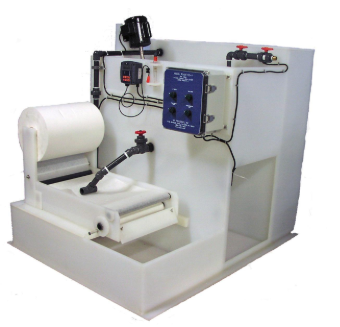
HPI Processes supplies coagulation/flocculation/filtration systems for metal finishing wastewater →
Step 4: Clarification and Filtration: Separating Solids from Clean Water
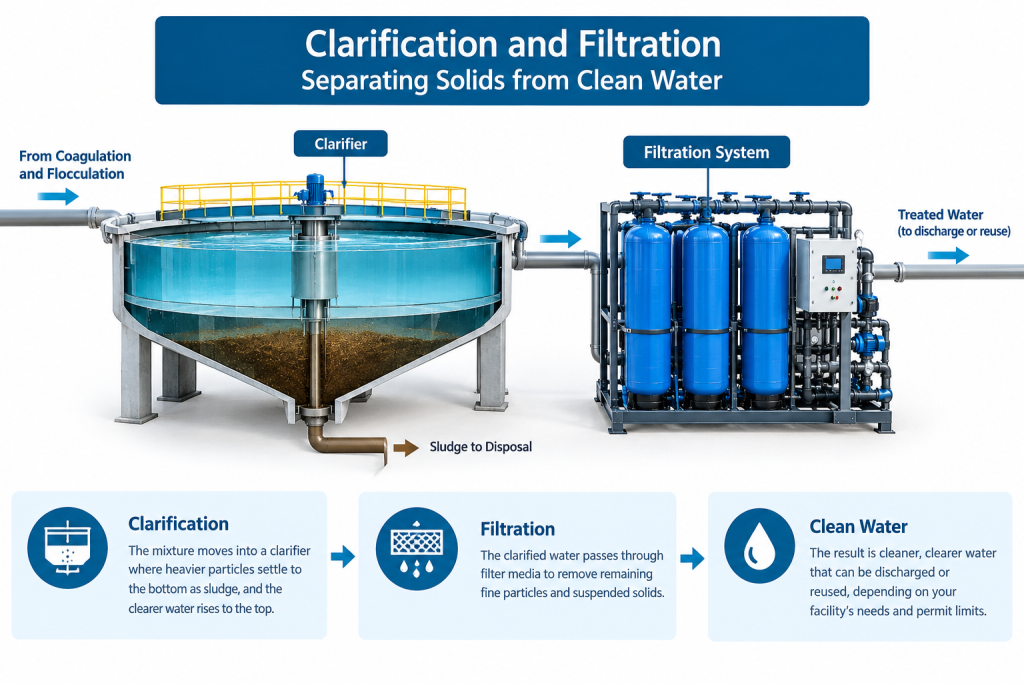
The large floc particles settle under gravity in a clarifier tank. Clarified water rises to the top and overflows to a collection channel for final polishing and pH adjustment before discharge.
Lamella (inclined plate) clarifiers are strongly recommended for industrial metal finishing applications. A lamella clarifier handles 3–5× the flow rate of a conventional round clarifier of the same plan area making them ideal for space-constrained facilities. The inclined plates multiply the effective settling surface area within a compact footprint.
Final filtration: After clarification, pass the effluent through a sand filter or cartridge filter to remove remaining fine particles. This polishing step is critical for consistently meeting the low monthly average discharge limits under 40 CFR Part 433.
Final pH adjustment: Trim the effluent to pH 6.0–9.0 before discharge the EPA-required range for POTW discharge. Many local POTW permits require a narrower range (pH 6.5–8.5). An automated pH neutralization system at the final discharge point provides continuous compliance.
Sludge management: The settled metal hydroxide sludge is pumped to a filter press for mechanical dewatering producing a dry metal hydroxide cake for disposal.
Critical: Metal hydroxide sludge from electroplating is classified as F006 listed hazardous waste under RCRA. It must be disposed of at a licensed RCRA hazardous waste facility. It cannot go to a regular landfill doing so is an independent RCRA violation.
Comparison of Heavy Metal Removal Methods
Chemical precipitation combined with coagulation/flocculation/filtration is the correct starting point for the vast majority of metal finishing and plating facilities. The table below summarizes how it compares to alternative treatment technologies:
| Method | Metals Removed | Removal Efficiency | Operating Cost | Best Application |
| Chemical Precipitation + Coagulation/Filtration | All common metals | 95–99.9% | Low–Medium | High concentration, high flow standard metal finishing |
| Ion Exchange | Specific metals | 99%+ | High | Low-concentration polishing, water reuse |
| Reverse Osmosis / Ultrafiltration | All metals | 95–99% | High | Sub-1 mg/L final limits, water recycle |
| Electrocoagulation | Most metals | 95–99% | Medium | Space-constrained, reduced chemical handling |
| Adsorption (activated carbon) | Mercury, cadmium | Good | Medium | Trace metal polishing as a final step |
For most metal finishing and plating facilities with metal concentrations in the 10–500 mg/L range, chemical precipitation combined with coagulation/flocculation/filtration is the proven, lowest-cost method to achieve compliance with 40 CFR Part 433 discharge limits. Ion exchange or membrane polishing may be added as a final step only when discharge permits require sub-1 mg/L final concentrations.
Common Mistakes That Cause System Failures
Using a single fixed pH for multi-metal wastewater: Each metal has its own optimal precipitation pH. Fixing the system at pH 9.0 may adequately precipitate copper but undertreated nickel in the same wastewater stream. Review your actual wastewater metal profile and confirm the target pH achieves compliance for all regulated metals.
No equalization tank: Plating and metal finishing operations discharge in batches not at a steady flow. Without an equalization tank to buffer these batch discharges, sudden concentration spikes overwhelm the chemical dosing system and cause treatment upsets. Size the equalization tank to accommodate at least one full batch discharge cycle.
Skipping jar testing before full-scale operation: Coagulant dose is highly specific to your wastewater’s metal concentration, pH, and suspended solids profile. Using a generic dose without jar testing is the single most common cause of poor floc formation and compliance failures in new or modified systems.
Over-mixing during flocculation: Aggressive stirring at the flocculation stage breaks apart the fragile floc particles before they can reach settleable size directly reducing clarifier efficiency and raising effluent metal concentrations.
No F006 sludge disposal plan: Metal hydroxide sludge from electroplating and metal finishing wastewater is F006 listed hazardous waste. Storing this sludge on-site beyond permitted accumulation times without a licensed disposal contract is an RCRA violation independent of your Clean Water Act compliance status.
How HPI Processes Can Help
HPI Processes, Inc. designs and builds complete heavy metal removal systems for industrial facilities including coagulation/flocculation/filtration treatment trains engineered for metal finishing, plating, and manufacturing wastewater streams. Systems are custom-sized to your flow rate, metal concentrations, and local discharge permit limits.
HPI also fabricates the plating and metal finishing process lines that generate this wastewater providing a single-source partner for both your process line and your compliance treatment system. After treatment, the clean water can be recycled back to your process using HPI’s industrial water recycling systems reducing fresh water consumption and lowering long-term operating costs.
For facilities that also require pH neutralization and chemical dosing systems as part of their discharge compliance program, HPI designs and integrates these as part of the complete treatment train.
Heavy Metal Treatment Is a Legal Requirement
Heavy metals from plating, finishing, and manufacturing operations are a legal and environmental responsibility not optional to address. The proven treatment path pH adjustment → chemical precipitation → coagulation/flocculation → clarification/filtration achieves 95–99.9% metal removal and meets EPA 40 CFR Part 433 discharge limits for zinc, copper, nickel, lead, cadmium, and chromium.
Automated systems with continuous pH and ORP monitoring remove human error, maintain consistent discharge compliance 24 hours a day, and generate the documentation your facility needs for POTW reporting.
Contact HPI Processes for a free technical consultation. Our engineers will design a heavy metal removal system sized for your facility, flow rate, and discharge requirements. Call 1-888-733-2832 or email sales@hpipro.com.
References:
https://www.ecfr.gov/current/title-40/chapter-I/subchapter-N/part-433